

Chicki Status as of: September 25, 2026 – AI gen
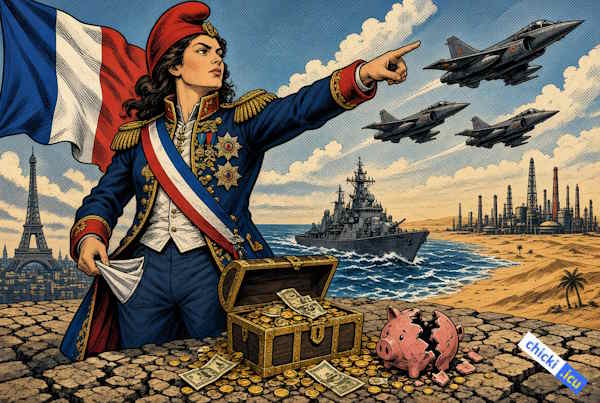
In 2026, France is acting as a power-projection player—while simultaneously grappling with a precarious fiscal situation. President Emmanuel Macron and Prime Minister Sébastien Lecornu (in office since autumn 2025, without a stable majority) are combining a global military presence with a budget that has failed to meet EU criteria for years. The question is not merely rhetorical: Paris has the capacity to project power, yet the funding gap is widening.
Geopolitical Operations
On September 25, 2026, Macron announced the deployment of troops, radar, and air defense systems to the Saudi oil port of Yanbu on the Red Sea. The objective: to protect the East-West Pipeline from Houthi attacks. Following the blockade of the Strait of Hormuz during the Iran War, Yanbu has become the critical alternative route (handling up to five million barrels daily). Macron emphasized that France does not intend to enter the conflict itself, but rather aims to safeguard oil prices and supplies.
Concurrently, Mission PEGASE 26 is underway: four Rafale jets, three aerial refueling tankers, two A400M transport aircraft, and approximately 300 troops are conducting a 38-to-40-day deployment via Greenland, Canada, Alaska, Japan, South Korea, Indonesia, India, Réunion, Qatar, and Egypt. The goal is to demonstrate a global, autonomous power-projection capability extending into the Indo-Pacific.
In the nuclear realm, Paris is broadening the scope of its deterrence strategy. Steering groups and joint exercises (such as “Poker”) are being established with Germany, Finland, and other NATO partners (totaling around ten nations), alongside the option to temporarily forward-deploy Rafale jets or submarines. Macron posits that in an unstable world, one must be feared in order to be free.
Other deployments include: support for Ukraine (training, radar systems, planned Rafale sales starting in 2028/29, exercises for a potential peacekeeping force); the NATO eastern flank (Mission Aigle in Romania); Mediterranean maneuvers (Morocco, Egypt, Greece); a return to Chad on a reduced scale (training, reconnaissance, no large bases); and a residual presence in Djibouti, Gabon, and Côte d’Ivoire. The combat mission in the Sahel (Barkhane) has ended; Russia is filling the resulting gaps. The 2026 provision for overseas operations (OPEX) stands at approximately €1.1–1.2 billion but remains traditionally underfunded. The Gulf deployment alone could approach €1 billion if the war continues, according to estimates by the Budget Ministry.
The updated Military Programming Law (*Loi de programmation militaire*) allocates an additional €36 billion through 2030. The defense budget for the “Défense” mission is set to rise from around €57 billion in 2026 to €63.3 billion in 2027; the Ministry of the Armed Forces’ total budget for 2026 stands at approximately €68 billion, including pensions. Defense spending is largely exempt from austerity measures.
No money in the coffers?
Public finances run counter to this ambition. The debt-to-GDP ratio stood at 115.7 percent in 2025 and is projected to rise to 119.3 percent in 2026—the highest level since 1978. A figure of 121.7 percent is expected for 2027. The deficit stood at 5.1 percent in 2025 and is projected at 5.4 percent for 2026, compared to initial targets of 5.0 and 4.6 percent, respectively. Growth for 2026 has been revised downward to around 0.5–0.6 percent. The energy shock resulting from the Middle East conflict is weighing on both revenues and expenditures.
Interest burdens and spreads are rising: the yield spread of French bonds over German bonds exceeded one percentage point in September 2026—the first time this has happened since the Eurozone crisis—with ten-year yields surpassing 4.5 percent. Government debt service costs for 2026 are estimated at around €59 billion. Lecornu plans €54 billion in austerity measures for 2027 to bring the deficit down to 5 percent. Parliament is fragmented, and the presidential election is approaching in 2027. The *Cour des comptes* (Court of Auditors) and the IMF consider the consolidation efforts insufficient: without a primary surplus, the debt-to-GDP ratio will not fall. France remains subject to the EU’s excessive deficit procedure.
Conclusion
France acts like a middle power with global ambitions—engaging in the Gulf, the Indo-Pacific, the European nuclear umbrella initiative, and Ukraine. At the same time, fiscal leeway is limited. Defense spending is increasing, while the rest of the budget is slated to be frozen. Operational capability exists in the short term; the long-term viability of this strategy depends on whether Paris can deliver—politically and fiscally—in 2027, or whether markets and voters will force a resolution to the contradiction between power projection and empty coffers.
 chicki -hot or not?






Leave a Reply