

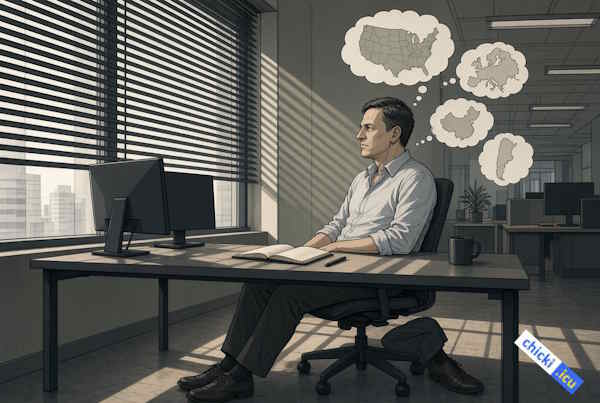
A fictional scene, based on positions expressed in the conversation with Mathias Döpfner for *Die Welt* on September 27, 2026. Neither a transcript nor a direct quote.
The open-plan office is quieter than the name implies. Someone has half-drawn the blinds; light falls in narrow strips across the desks. Peter Thiel is not sitting at the head of a conference table but at an empty spot between two monitors that no one has turned on. He has tucked his shoes under his chair. A notebook lies open before him, yet it is blank. He is not writing. He gazes out at the city as if it were a chart that has not yet made up its mind.
He thinks in terms of continents, not headlines.
America first—because it is where he has lived since he was ten months old, and because it is the only place where demand for AI is truly picking up right now. Companies sense that they need to prepare. It is not enthusiasm; it is more of a reflex. Thiel views this as the pro-American aspect of the story: the revolution is happening here, in bits—bits that might, this time, grow large enough to become something more than just the Internet. Whether they will bring the world of atoms along with them—mechanical engineering, energy, the very stuff of homes and factories—remains an open question. Without this second half, he believes, it all remains a zero-sum game. Winners create losers, and politics grows louder without becoming any wiser.
From where he sits, Europe appears as if seen through frosted glass. The lag is no longer a matter of pace, but of mindset. The sense of urgency is missing. People debate whether acceleration is dangerous, while elsewhere, orders are already being placed. Germany sits at the center, not the periphery: in the heart of Europe, with Europe itself still at the center of what is known as the West. When the West faces a crisis, Germany shares in it. The West has never quite managed to excise the country from its heart, even if it long kept it at intellectual arm’s length. That does not make the diagnosis any less severe. Since the mid-nineties—by his own reckoning—something has snapped. Among America’s young and wealthiest, most built their fortunes themselves. In Germany, within the same age group, wealth is inherited. The country used to produce major corporations; today, success is often sold off before it can go global. Fear of failure, perhaps. Or fear of massive success.
He takes China seriously without using it as an excuse. The rivalry is real. He considers it a fallacy to draw a moral equivalence between China and America. At the same time, he does not pin everything on Beijing. The greater part of the West’s paralysis is self-inflicted: regulation that seeks to act like a world government without actually being one; encyclicals and moratoriums that are heard in Washington but ignored by the Communist Party. A brake that slows down only one side is not caution; it is a downward slope.
I was born in Germany, in Frankfurt am Main. We emigrated to the USA in 1968, when I was ten months old. For the first ten to twelve years, we spoke German at home. Then, English gradually took over. But as a child, I traveled to Germany frequently; my grandparents lived here. That is why I have always felt a strong connection to Germany, even if somewhat from the outside. Somehow, I understand the country.
Peter Thiel – Welt September 27, 2026
For him, Argentina is not located in South America, but in the future of others—a country that was once among the wealthiest and then endured decades of relative decline. That is why so many are watching it. Not merely out of curiosity about Milei, but out of a desire to know whether one can learn from another nation’s history before sliding into a century-long decline oneself. Thiel dislikes the Leninist notion that things must get truly terrible first. He simply has the impression that the West is dissatisfied enough to complain, yet not dissatisfied enough to rebuild. Hence, the slow slide. Expansive welfare states, high taxes, massive deficits—this model held up as long as interest rates hovered at zero. No longer. There are three ways out: cut spending, raise taxes, or keep borrowing and kicking the can down the road. Since 2008, the third option has been the path taken. He believes that door is closing.
Sitting at this table, he also finds himself thinking about three men—without actually calling them.
To him, Elon Musk is proof that the physical world—atoms—still matters if someone refuses to remain confined to software. Rockets, cars, the raw reality of physics. At the same time, Thiel views the loudest warnings about runaway intelligence as partly science fiction, yet not absurd enough to ignore. A five or ten percent probability is enough to cause unease. Yet, for him, it is not enough to halt development. Truly hitting the brakes would require a world government with real enforcement power. For the libertarian in him, that would be a cure worse than the disease. Musk pushes forward while simultaneously sounding the alarm. Thiel finds this human—and messy. He wouldn’t bet everything on a single person, not even this one. Progress is not a character trait; it is a direction that a society either still desires or merely manages.
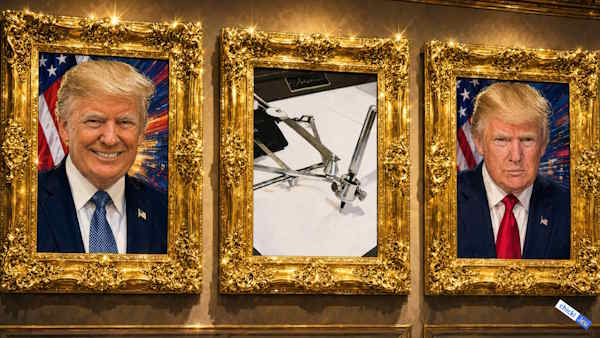
To him, Donald Trump remains a symptom, not a policy agenda. His rise reflected issues the establishment could no longer resolve: growth, the costs of globalization, and entanglements in the Middle East. There were plenty of failures—internal infighting during the first administration, and in the second the excessive cult of loyalty. In both cases, competence would have been cheaper than ideological conformity. Nevertheless, Thiel views Trump less as a cause and more as a symptom of exhaustion. The greater concern lies with the other side. The Democrats are the true party of the state, the party of institutions. If the Democratic Socialists were to take them over, it would not merely be a shift in rhetoric, but potentially the end of what still holds America together. They possess dynamism, youth, and charisma—qualities the establishment often lacks. Thiel states this without warmth or malice. He considers Vance a better Republican figure than Rubio, yet believes the more crucial question is whom the Democrats will field when they think victory is already in the bag.
Friedrich Merz is the most concrete of the three, and for that very reason, the most indistinct. One can reasonably argue, Thiel thinks, that the government is failing in many respects. At the same time, one can assume it will remain in power for years because there is no convincing alternative on the horizon. His instinct tells him this state of drifting will persist. The established parties underestimate the scale of the situation. For him, the Left and the AfD are not solutions but indicators. The former at least addresses issues like rents, the lack of housing construction, and the barriers to wealth accumulation—and thus finds an audience among the young, alarmingly so in Berlin. The latter is the echo of a political center that can no longer come up with a narrative for economic the future. Regarding Russia, China, and Israel, he believes the AfD is wrong on all three counts—a notable fact, given how difficult it is to be wrong about all three simultaneously. Nevertheless, he considers it the wrong reflex to declare these topics off-limits for discussion. Gerontocracies—run by the old for the old—create these very fringes; they do not resolve them.
Outside, the light is growing flatter. In the open-plan office, someone stands up, gets coffee, and sits back down. Thiel does not turn the page of his empty notebook. He does not believe that extremist parties will cure the root causes of their own rise to prominence. Nor does he believe that moralizing can compensate for incompetence. “Good versus evil” is the kind of debate every talk show excels at. “Good versus bad”—functional versus incompetent—is the debate hardly anyone is having. When ninety-nine out of a hundred decision-makers simply lack the ability to do the job, *that* is the issue. Not their ideology.
He stands up, pushes back his chair, and leaves the notebook behind. Continents do not change simply because someone in an open-plan office has been doing some thinking. They change when growth once again becomes a story people believe in—or when it finally ceases to be one at all. Both outcomes remain possible. The only scenario he considers already decided is the middle ground: the long, drawn-out deferral.

Chicki – hot or not? AI gen Text and Images





Leave a Reply