

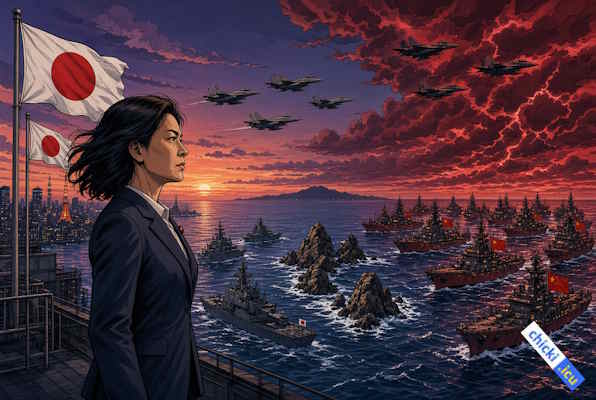
Japan is building a counterweight to China under Prime Minister Sanae Takaichi — militarily, diplomatically and economically. What Xi Jinping framed in Washington as a reminder of the shared fight against Japanese militarism in the Second World War was a barely veiled warning: the UN Charter still formally lists Japan and Germany as “enemy states.” The clause has been treated as obsolete since 1995, but it has not been deleted. Beijing revived it after Takaichi took office in autumn 2025 in order to delegitimize Tokyo’s rearmament. Takaichi wants the passage struck; China calls the article “vital.”
Behind the wording lies power politics. Takaichi is continuing the course Shinzo Abe set in motion thirteen years ago. She has raised the defense budget to 2 percent of economic output, a year earlier than planned. By the end of the year the 2022 security strategy is to be revised. The aim is not only defense capability, but readiness for war — and the ability to hold out, if necessary, without the United States. The alliance with Washington remains central; confidence in automatic support is fading.
The balance has reversed since 2000. Then Japan still spent more on its military than China; today, according to Sipri, Beijing spends 5.4 times as much. North Korea is a nuclear power, and the two are drawing closer. China is pressing its claims to the Senkaku Islands more aggressively and tightening pressure on Taiwan. For Tokyo that is existential: sea lanes carrying 96 percent of imports run past Taiwan. In November 2025 Takaichi called a Chinese attack on Taiwan a situation that could threaten Japan’s survival. Beijing answered with diplomatic attacks and anti-Japanese propaganda. Taiwanese security expert Alexander Huang says sentiment in China is so heated that some would rather see a conflict with Japan than one with Taiwan.
Tokyo nevertheless remains dependent on Washington. Ken Jimbo of the Rais think tank considers even the combined strength of Japan, Australia, South Korea and Taiwan insufficient — and even with the United States, superiority is no longer assured.
The answer is a dual strategy. First, keep the United States in the region: no public criticism of Trump, a larger share of the military burden, and an investment pledge of 550 billion dollars. Second, deterrence of its own. Japan is buying cruise missiles, developing ballistic missiles that can reach China, widening the powers of the Self-Defense Forces and tying them more closely to US forces. Defense Minister Shinjiro Koizumi is questioning the three non-nuclear principles; debate on nuclear weapons or nuclear submarines is no longer meant to be taboo. Exports of lethal weapon systems have been cleared, strengthening domestic industry — Mitsubishi Heavy beat Thyssenkrupp for an Australian frigate order.
In parallel, the alliance network is expanding. Alongside the classic bilateral US pacts, minilaterals are forming with Washington’s blessing: troop exchanges with Australia and the Philippines, and trilateral formats with Australia and New Zealand and with Australia and Indonesia. Especially consequential is closer trilateral cooperation among Japan, the United States and South Korea — blocked for decades by the dispute over the colonial era, now driven by a shared sense of threat.











Leave a Reply