

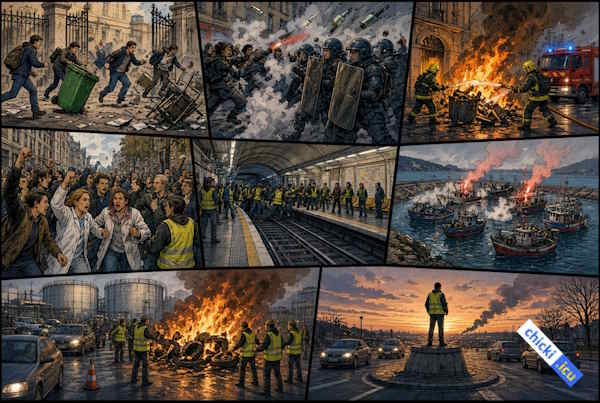
France is juggling three protest waves at once, and they are no longer confined to Paris.
High-school blockades that began about a week ago in the Paris suburbs have spread nationwide. By Wednesday the Interior Ministry counted 356 affected lycées; on Thursday the student union said dozens of university campuses had joined, including sites in Paris, Lyon, Marseille, Strasbourg and Reims. Students want substitute teachers, smaller classes and usable buildings. The protests have turned violent: 625 people were detained on Wednesday alone, 83 police officers and gendarmes were injured that day, and 119 pupils and staff have been hurt since the blockades began. Trash fires, projectiles and tear gas have been reported from Lille and Nantes to Bordeaux and Saint-Denis. In Marseille a headteacher was doused in petrol and injured. Prime Minister Sébastien Lecornu called a crisis meeting. President Macron called the grievances legitimate and the violence unacceptable. Smaller towns — Reims, Laon, Épernay, Grenoble — are involved too.
That unrest overlaps with a public-sector strike on 29 September against the 2027 budget, which unions say includes about €54 billion in cuts and another pay freeze. Unions claimed roughly 300,000 marchers in some 170 towns; police put the Paris turnout near 30,000. The draft budget was presented on Thursday.
Fuel is the third fuse. Since mid-September, diesel near a record €2.37 a litre — tied to the Strait of Hormuz disruption in the 2026 Iran war — has brought out fishermen, energy workers and farmers. Ports at Nice and Sète were blocked; depots at Frontignan and Fos-sur-Mer were cut off with tire fires. EDF reported unusually high strike participation. Lecornu raised industry fuel subsidies through December. The anger did not stop.
In Paris a CGT-RATP strike notice has covered metro, RER and buses since 28 September. Pilots and cabin crew are due to strike 17–21 October.
The yellow-vest parallel is the fuel price and the online call for a leaderless mobilisation on 17 October, echoing 17 November 2018. The backdrop is familiar: cost of living, Macron, a presidential election ahead in 2027. The street so far is not. This round is school barricades and union marches, not roundabout occupations. Whether 17 October becomes a second gilets-jaunes wave is still open.
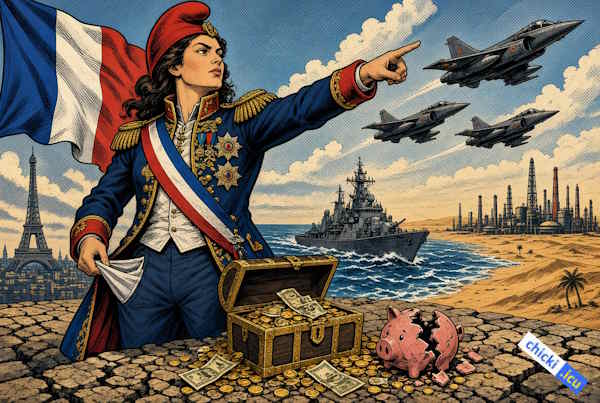
 Chicki – hot or not? AI gen










Leave a Reply