

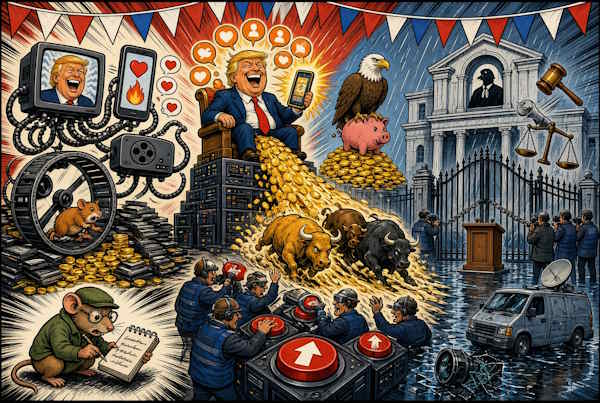
“Trump TV” is not a cable channel but a 24/7 YouTube livestream from the White House featuring speeches, signing ceremonies, and archival clips. It launched after President Trump banned CNN, MS NOW (formerly MSNBC), and Politico from the White House grounds. This move marks the latest phase of a strategy that has remained fundamentally the same for years: transmitting his own message unfiltered via platforms that Trump controls—or that, at the very least, do not filter the content through an editorial team.
What is Trump TV?
On the evening of September 21, 2026, the White House launched a continuous stream on its official YouTube channel: “TRUMP TV: The Essentials Station.” It was promoted as a venue for the administration’s “greatest moments”—available around the clock, “unfiltered,” and “updated in real time.”
In practice, this means there are no hosts, no dedicated newsroom, and no studio format. The stream plays speeches, bill signings, public appearances, and past highlights on a continuous loop. The inaugural broadcast featured a speech delivered at Mount Rushmore on July 3, 2026; the following morning, the lineup included a speech given in March at a packaging plant in Kentucky. Viewers tuning in see less of a structured program and more of an endless loop of official self-promotion.
Technically, the channel operates via existing White House platforms (YouTube, WhiteHouse.gov, and the app). It is explicitly a government initiative—distinct from the commercial streaming service offered by Trump’s media company. The promotional campaign was more elaborate than the content itself: a trailer featuring a remix of “Video Killed the Radio Star” superimposed the Trump TV logo over scenes from *The Office*, *Seinfeld*, *Breaking Bad*, *Family Guy*, *Friends*, and other series.
Viewership and Criticism
The livestream’s reach was limited during its first few days. Reports indicate a launch audience in the low four-figure range, with numbers dropping to fewer than 500 concurrent viewers at times. For comparison, a prime-time show on Fox News draws millions of viewers. While the White House YouTube channel has millions of subscribers, subscribers are not the same as live viewers.
Critics—including *The Guardian*, *The Daily Beast*, and Governor Gavin Newsom—have labeled it “state TV” or “North Korea TV.” The White House argues the opposite: claiming the press has misreported or ignored the administration’s achievements, they maintain that Trump TV provides the raw, original footage. Both can be true at the same time: the images are official, the selection is partisan, and independent contextualization is absent by design.
Why “His Holiness” relies so heavily on social media
The ironic moniker captures a reality: Trump treats public communication like a pulpit. Not because he has studied the Vatican, but because direct address is his most potent weapon—and because he views the journalistic intermediary as a hostile force.
Political logic
• Unfiltered: No editor trims the content, no anchor asks follow-up questions. A Truth Social post serves simultaneously as a press release, a declaration of war, and a means to stir up sentiment.
• Agenda-setting: Journalists are compelled to quote his posts regardless. This allows him to dictate the conversation without having to appear on a talk show.
• A dedicated following: In terms of user numbers, Truth Social is small compared to X or Facebook. Yet, for the MAGA base, it is the central gathering place. From there, messages are disseminated into right-wing media and onto X.
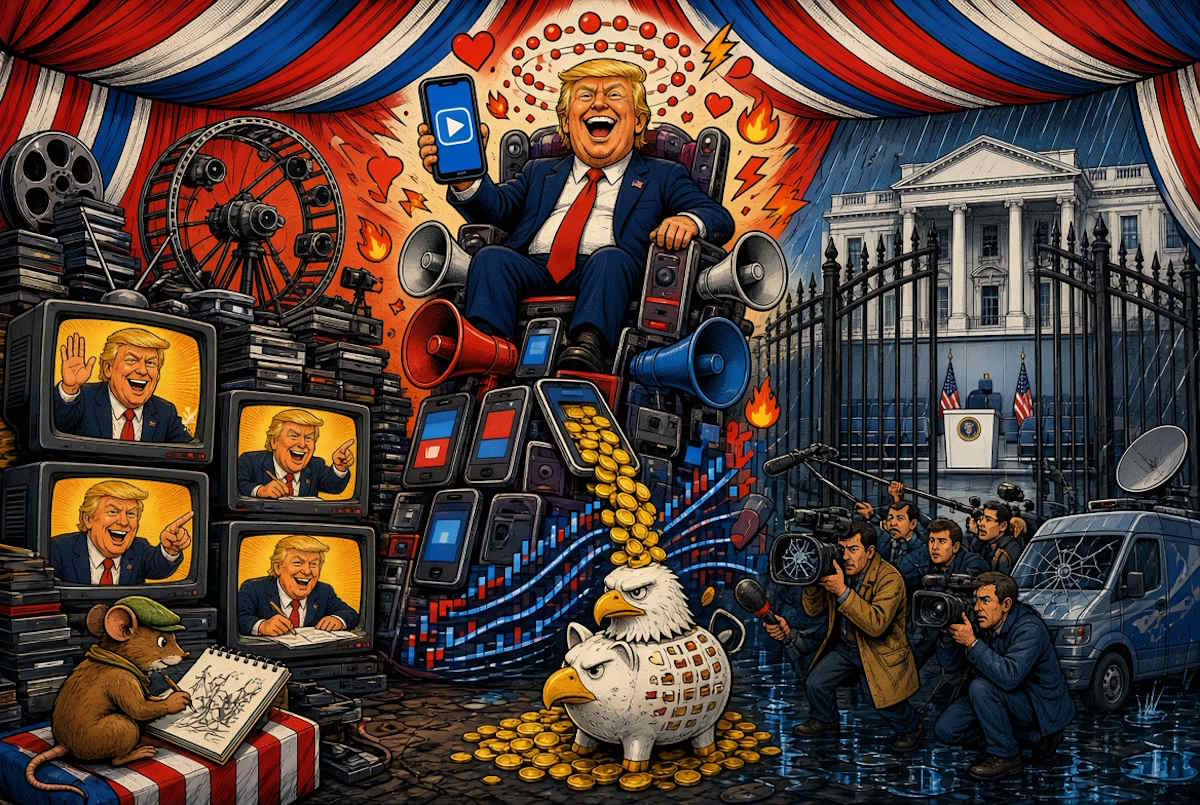
• Style and addiction: Trump posts in bursts—hundreds of “Truths” in a few weeks, sometimes dozens in a single day. Insults, personnel announcements, foreign policy, and AI-generated images of himself as a warrior or a stock market wizard appear side by side. It is a mix of communication style and self-reinforcement: likes, reposts, and outrage.
Economic Logic
Here, the bully pulpit is transformed into a business model. Through a trust structure (the Donald J. Trump Revocable Trust, with Donald Trump Jr. as trustee), Trump is the largest shareholder of TMTG—reports cite a stake of around 41 percent, or just over 114 million shares. The more active he is on Truth Social, the more relevant the platform becomes.
In the summer of 2026, TMTG launched “Truth API”: according to interim CEO Kevin McGurn, high-frequency traders and other clients pay between $60,000 and $100,000 a month for an ultra-fast data feed covering the accounts with the widest reach—the most important of which is the President’s. Trump uses the platform to announce tariffs, personnel appointments, and foreign policy moves. Markets often react within minutes. Those who see the posts seconds earlier can trade accordingly; the company’s owner profits from the subscription.
Critics call this a textbook conflict of interest: the office of the presidency generates the information, while the private company sells the head start. The company itself argues that it is merely licensing publicly visible posts and building a lasting media business. Both perspectives can be described without taking a side: the incentives clearly point upward as long as the President remains on his own platform.
A Brief History
From 2015 to 2021, Twitter served as the amphitheater. Following the de-platforming of major accounts in January 2021, Truth Social emerged in 2022. A licensing agreement stipulated that non-political posts appear there first; in practice, however, a sitting president tends to classify almost everything as political. Even after the return to X, Truth Social remained the primary channel—for reasons of branding, contracts, and revenue.
The White House institutionalized this logic in 2025–26: informal posts replacing sterile press releases, AI-generated images, and the language of memes. Advisors call this “meeting people where they are.” It is a modern approach. It is also a method of systematically blurring the lines between the office, the individual, and the brand.
What CNN actually did
The short version from supporters: CNN has been lying for years and doesn’t belong in the White House. The short version from opponents: Trump is punishing unfavorable coverage and calling it a matter of national security. The actual record lies somewhere in between—and is less flattering for both sides than the slogans suggest.
The immediate trigger (September 18–23, 2026)
On September 18, 2026, Trump wrote on Truth Social that he was banning “Fake News CNN,” “MSNOW,” and Politico from the White House, effective immediately, citing constant “FICTION and LIES.” Other outlets would follow. That same day, speaking in the Oval Office, he stated there was no single trigger, but rather a “cumulative history over the last two years”; he claimed these outlets wrote negatively on purpose to diminish him and the Republicans.
On September 21, the three media organizations filed suit. They argued that the ban was based on viewpoint, imposed without a hearing or due process—a violation of the First Amendment and constitutional due process rights. Meanwhile, ABC, CBS, NBC, and even Fox News refused to take over the shared television pool feed when it was CNN’s scheduled turn on Monday. Without a pool camera, the networks lacked shared footage of departures and official events. “Trump TV” was intended to fill precisely this gap.
Specific allegations made by the administration later
It was only after the lawsuit was filed that the White House sent out letters explaining its reasoning. These letters went beyond mere “Fake News” accusations, citing violations of professional standards, “verifiable falsehoods” regarding national security, and the publication of sensitive or classified information. Access to the White House, they maintained, is a privilege, not a right.
The cited examples:
• CNN: A report from January 2026 regarding “top-secret” construction details of a bunker beneath the East Wing—the site where Trump is having a ballroom built; …as well as reports on the Iran war.
• Politico: Publication of a document regarding the funding of the ballroom, detailing how the Secret Service planned security upgrades; additional pieces on Iran and Russia sanctions.
• MS NOW: Coverage of the Iran conflict (including a report citing sources who claimed Trump underestimated Iran’s willingness to resume hostilities) and an alleged leak investigation.
Key to the assessment: Trump himself had publicly justified the ban by citing “negative stories,” not a specific breach of classified information. National security concerns appeared only later in legal filings. The plaintiffs characterize this as a post-hoc justification. Judge Timothy J. Kelly (a 2017 Trump appointee who had previously ordered the restoration of CNN credentials in 2018) expressed skepticism during the September 23 hearing—regarding both the security argument and the lack of due process.
What CNN has actually done over the years
Anyone familiar only with September 2026 would not understand the animosity. Trump and CNN have been at odds since his first run for office. An honest assessment includes errors and exaggerations, as well as legitimate scrutiny:
• Ongoing feud: Since 2016, Trump has labeled CNN “Fake News” and called journalists “enemies of the people.” CNN has framed him negatively more often and more harshly than Fox has. This involves both allegations of bias and a business model: outrage keeps viewers on both sides engaged.
• 2018, Jim Acosta: Following a heated briefing, the White House revoked the CNN correspondent’s press pass. A court ordered its restoration. The current case represents an escalation of that same pattern—this time targeting entire newsrooms. • Editorial errors: Like almost every major US media outlet, CNN has had to correct, retract, or tone down stories (such as Russia coverage during the first term, sensationalized predictions, and talk-show opinions masquerading as news). This is a quality issue. It is not automatically legal grounds for barring a media outlet from the seat of government.
• Recent reporting: The stories cited by the administration—regarding the bunker, the ballroom, and Iran—represent exactly the kind of coverage a president dislikes: construction projects at the seat of government, security infrastructure, and military operations. Whether details were too sensitive is a matter for security officials and the courts—not for a Truth Social proclamation.
CNN maintains that the network stands by its team and has the right to report without government interference. Trump argues that those who write lies should not sit in the “People’s House.” The Constitution protects freedom of the press; it does not compel the president to guarantee every broadcaster a seat in the briefing room. The legal battle is playing out in precisely this gray area.
Contextualization
Three levels should be kept distinct; otherwise, analysis turns into fan fiction. Communication: Trump has transformed the office into a platform for continuous direct address. Social media is the cheapest, fastest, and most personal medium for this. “Trump TV” is the video version of the same concept—born the moment traditional camera crews were no longer present.
Business: As long as TMTG profits from market valuation and data subscriptions, …every post counts as an asset. This explains why the President does not simply return to X permanently, even though the reach there would be greater.
A watered-down version of the separation of powers: A president is allowed to find journalists rude. However, a president who ejects entire newsrooms from the seat of government because he dislikes their tone—and subsequently dubs his own stream “Greatest Hits”—blurs the line between government communication and a state broadcaster. Whether this holds up legally is for the court in Washington to decide; whether it holds up politically is for the midterms to determine.
What CNN has “done,” then, is less a matter of a single scandal than a years-long, mutually profitable hostility—exacerbated by war reporting, a controversial construction project at the White House, and a president who treats media criticism as an affront to his majesty. Anyone expecting saintliness will be disappointed by both sides: neither the stream nor the defendants preach asceticism.
Based on contemporaneous reporting from September 18 to 23, 2026 (including the *New York Times*, *Washington Post*, CNN, *USA Today*, *The Verge*, *The Guardian*, Reuters, Bloomberg, and court documents from the lawsuit filed by CNN, MS NOW, and *Politico* against the administration), as well as previously documented information regarding Truth Social, TMTG, Truth+, and Truth API. Stream viewership figures are derived from media analyses covering the first 48 hours and are subject to fluctuation. As of the date of this report, court rulings had not yet reached finality.
AI gen by chicki: hot or not?







Leave a Reply